


In Every Generation, She Rose
How Albertus Women Have Shaped a Century of Change
By Steven Blackburn
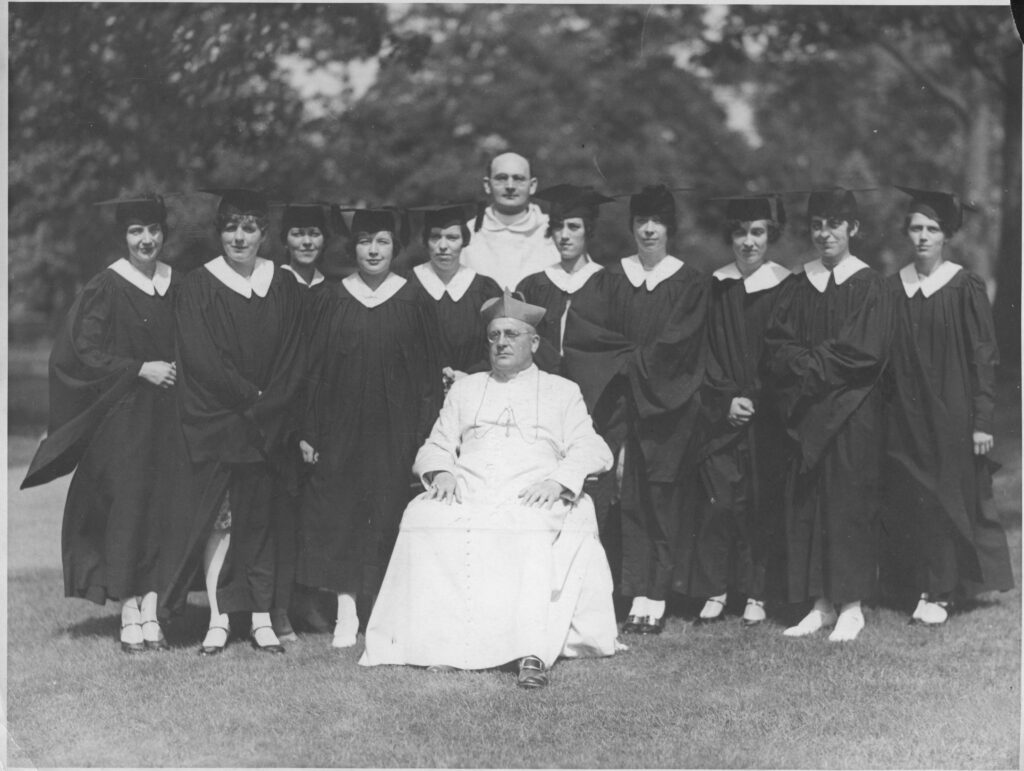
When the Dominican Sisters of Peace opened Albertus Magnus College’s doors in 1925, the Congregation of Catholic Sisters sought to expand women’s access to education, professions, leadership and public voice in a male-dominated world. The Sisters accomplished this and more. Ever since that first class, their graduates have exceeded even the founders’ boldest hopes, trailblazing across generations and shaping law, policy, scholarship and service far beyond the Prospect Street campus in Connecticut.
“One of the most powerful things you see when you study Albertus alumni is that their impact often extends far beyond their own success. These women became teachers, advocates, lawmakers, caregivers and leaders. Again and again, they took what they learned here and turned it outward,” says Catie White, interim director of library services and author of “Albertus Magnus College: Fearless Endless Truth: Celebrating a Century of Impact Through Education, Faith, and Tradition.”
The Class That Set Women’s Capability into Motion
For most institutions just starting out, it takes years — sometimes generations — to fully see the impact of their founding vision. But Albertus’ inaugural graduating class of 1928, though made up of just 12 students, began making a difference immediately. Four graduates entered education as schoolteachers, two followed the Sisters’ Catholic teachings as religious sisters, two went on to Yale for advanced study, one became an actress and two entered the emerging telephone industry.
“In the 1920s, telephones were brand new,” says White. “Entering that profession then is the equivalent of students today going into cutting-edge fields like cybersecurity or artificial intelligence — industries that actively shape how society functions.”

A Legacy Rooted in One Family — and Many Futures
As the decades unfolded, Albertus women continued to press into spaces where women were rarely welcomed. Although women had earned law degrees as early as the 1920s, few were able to practice, let alone rise to the bench. Mary Goode Rogan ’36 pursued both.
“She promptly took her Albertus degree out for a drive directly down Prospect Street to Yale Law School, where she was one of only four women to earn a law degree in 1938,” says her great-niece Carolyn Behan, executive director of college events.
“Mary balanced raising six children with a demanding legal career and eventually served as a Superior Court judge for Los Angeles County until her retirement in 1990,” adds Behan, whose family legacy at Albertus stretches back to the inaugural class of 1928. “At all of about five-feet tall, she was both feared and revered.”
Breaking Barriers in the Mid-Century Courts
A few graduating classes later, Ellen Bree Burns ’44 would shatter multiple glass ceilings in Connecticut’s judiciary. She became the state’s first female Superior Court judge in 1974, its first female federal judge in 1978 and the first woman to serve as chief judge of the U.S. District Court of Connecticut.
“She was the first of many,” says Dr. Rosa E. Rivera-Hainaj, vice president for academic affairs and dean of faculty. “I would put her firmly in the category of barrier-breaking individuals.”
Dr. Rivera-Hainaj notes that Burns’ leadership was shaped in part by the expectations placed on Albertus students during World War II.
“The women at the college were keenly aware of what was happening in the world and felt obligated to do their part,” Dr. Rivera-Hainaj says, later citing Sister Mary Boniface Kriener in White’s book. Kriener observed that there was, “a development in the maturity of mind on campus — a seriousness and a realization that college life meant hard work and future sacrifices.”
Margaret Heckler and the Power of Policy
One of the most nationally consequential Albertus alumnae is Margaret Heckler ’32, whose life and career are chronicled in “A Woman of Firsts: Margaret Heckler, Political Trailblazer” by her daughter-in-law, Kim Heckler.
Margaret Heckler (O’Shaugnessy) built a far-reaching political career that spanned five presidential administrations, working alongside Presidents Johnson, Nixon, Ford, Carter and Reagan. When she entered Congress in 1967, the barriers women faced were unmistakable. “Congress consisted of 70 men — and Margaret,” Kim Heckler says.
Margaret Heckler held numerous roles once considered unattainable for women, including becoming the first woman U.S. ambassador to Ireland. In this position, she was a trailblazer, organizing the first women’s delegation from Congress to China. She also founded the first women’s caucus in Congress and the first federalized hospice program — transforming end-of-life care into a Medicare benefit rather than a privilege reserved for those who could pay privately.
Her most enduring legislative legacy is the Equal Credit Opportunity Act of 1974, which gave women the legal right to obtain credit in their own names. “It was a significant and landmark piece of legislation that changed the playing field for women,” says Kim Heckler. Margaret Heckler also co-sponsored Title IX, advancing gender equity in education, and elevated congressional focus on childcare and support for working women.
Margaret Heckler’s influence extended beyond her own positions. Through private counsel, she persuaded President Ronald Reagan to appoint the first woman to the U.S. Supreme Court, Sandra Day O’Connor.
“Margaret understood policy as a tool for dignity,” Kim Heckler concludes. “She believed women deserved autonomy — not just socially, but financially and legally. That conviction was shaped by her education and by a college that taught women to think critically, ethically, and courageously.”
Carrying the Legacy Forward
Albertus’ legacy of impact is not confined to its early decades. Contemporary alumnae continue to shape fields where women remain underrepresented, including sports media. Chelsea Sherrod ’16 has already built a distinguished career in sports broadcasting.
Sherrod remains deeply connected to Albertus Magnus, mentoring students, visiting classes, serving on an intercollegiate athletics board committee and, most recently, returning to campus as keynote speaker for the 2024 Frangelico Leadership Luncheon.

“Albertus was founded on the belief that when women are educated, communities change,” says Dr. Rivera-Hainaj. “That truth has held for a hundred years — and it’s still unfolding.”
Steven Blackburn is a freelance writer with more than 10 years of journalism experience in various fields, including U.S. education and Connecticut community interest stories. He lives in Winsted.
More Stories
Albertus Magnus College Marks Its Centennial: 100 Years of Study, Prayer, Community and Service
Goodbye Summer, Hello School
Exploring the Shift in Parental Support During Adolescence